
Top Signs You Need Garage Door Service – Don’t Ignore These
A garage door that’s gotten louder, slower, or twitchier over the past six months isn’t “just how it is now.” Those changes are how the door tells you something is wearing out, and the warning usually comes well before the failure. Most of what we see in Norwood starts as a sound, a pause, or a small sag that gets explained away for months. Below are the signals worth taking seriously, what each one usually means, and how to tell a same-week repair from a stop-using-it-now problem. If you’d rather not climb around a door yourself, call (866) 783-4096 and we’ll take a look.
Why does my garage door suddenly sound different?
Sound is the earliest signal a garage door gives you, and the type of noise points to a specific part. A door that used to hum along quietly and now announces itself to the whole street is telling you where the wear is. Here’s how to read it:
- Grinding usually comes from worn rollers or a torsion shaft that’s losing lubrication and starting to bind. It’s a moving-metal-on-metal sound, and it tends to get worse in dry, cold stretches.
- Popping points to the springs or the cable drums. A single sharp pop when the door starts to move is a spring under changing tension, and it deserves a close look rather than a shrug.
- Squealing traces back to dry hinges, rollers, or the torsion tube. It’s the least urgent of the three, but it’s also the easiest to fix before it accelerates wear on everything around it.
- A rhythmic thump or rattle often means a loose track, a bent panel, or a roller that’s come out of alignment.
Here in Norwood we get real seasonal swings, and the freeze-thaw cycle works on all of these. Lubricant thickens in the cold, metal contracts, and a door that was quiet in October starts grinding in January. That’s not a coincidence, and it isn’t something to wait out. If a noise showed up with the first cold snap and hasn’t faded, the part behind it needs attention.
My door reverses for no reason. Is the opener failing?
Usually not. A door that goes down and then reverses back up on its own is most often the safety sensor doing its job, not the opener malfunctioning. Those small photo-eye sensors near the floor bounce an invisible beam across the opening. If anything blocks that beam, if the sensors get knocked out of alignment, or if the lenses are dirty or fogged, the opener reads it as an obstruction and sends the door back up.
Before you blame the opener, check a few things from the ground:
- Look for anything in the beam’s path. A shifted recycling bin, a leaf pile, or the shop vac parked a little too far forward will do it.
- Wipe both sensor lenses with a dry cloth. Dust and cobweb film build up on them faster than people expect.
- Check that both sensor brackets point at each other and none has been nudged. A brush with the car bumper is enough to skew one.
- Look at the indicator light on each sensor. Most units have a small LED that changes when the beam is broken or the alignment is off.
If the sensors are clean, aligned, and clear, and the door still reverses, then it’s worth having the opener itself checked. We work on LiftMaster and Chamberlain systems regularly, and both have sensor logic that can misread when the wiring or a sensor’s internal part ages. On a brand-agnostic note, this is the kind of thing a handyman generalist often misdiagnoses as “the opener’s going.” It usually isn’t. If you’d like that diagnosed properly, our team handles garage door opener repair and can sort out whether it’s the sensor, the wiring, or the unit itself.
Related services in Norwood: garage door opener repair handles sensors, remotes, and opener logic; garage door spring repair covers torsion and extension springs once a noise or balance test points there.
The 30-second balance test that catches spring problems early
You can find out whether your spring tension is off without touching a spring. This test works on any door and tells you a lot. Do it with the door closed, from a safe spot, using the manual release only when the door is in the down position:
- Pull the manual release cord to disconnect the opener (only with the door fully closed, so it isn’t under load).
- Lift the door by hand to about halfway, then let go gently.
- Watch what it does. A properly balanced door should hold roughly where you left it, maybe drifting a few inches. A door that sags hard toward the floor or shoots back up is out of balance.
An out-of-balance door almost always means a spring is losing tension, and the opener has quietly been compensating by working harder to lift a door it was never sized to carry. That extra strain is what shortens opener life. A garage door that takes a few seconds longer to open than it did six months ago is the same story in slow motion. It’s the opener straining against a spring that’s no longer helping.
Here’s the safety part, and we don’t soften it: torsion and extension springs are the most dangerous component of any garage door system. They’re under extreme tension, and a spring that lets go can cause serious injury. Do the balance test from the ground and leave the spring itself alone. That’s exactly the kind of work a trained technician should handle. If the test shows your door is out of balance, give us a call and we’ll check the springs properly.
What should I look for on cables, rollers, and tracks?
Some of the most telling clues are visible from the ground with a flashlight, no ladder required. If you see any of the following, you’ve found a real problem rather than a quirk:
- Frayed cables. Look at the cables that run along the sides. They should be smooth and tight. Fraying, a bird’s-nest of loose wire, or a cable that looks slack is a stop-using-the-door signal, not a wait-and-see one.
- Rust patterns. Even rust on rollers and hinges tells a story. Uneven rust on one side suggests that side is binding or out of alignment.
- Track gaps. Run your eye down each vertical and horizontal track. Any gap, bend, or section that’s pulled away from the door frame needs attention. A door running on a bent track wears out rollers fast and can jump the track entirely.
- Worn rollers. Nylon rollers should look round and solid. Flattened spots, cracks, or steel rollers with visible wear mean replacement is due.
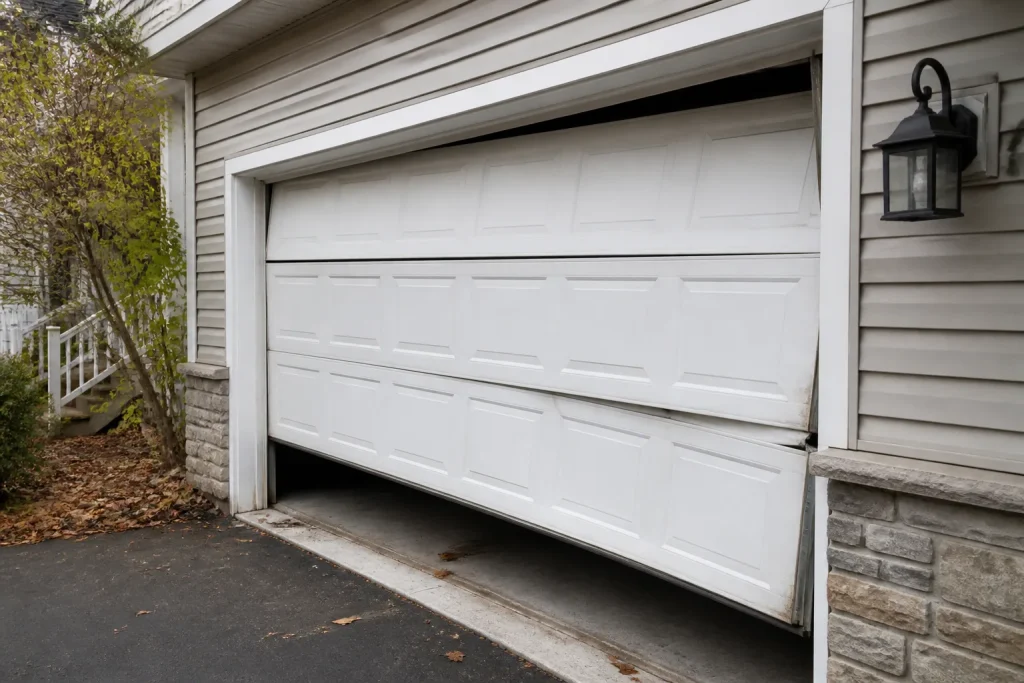
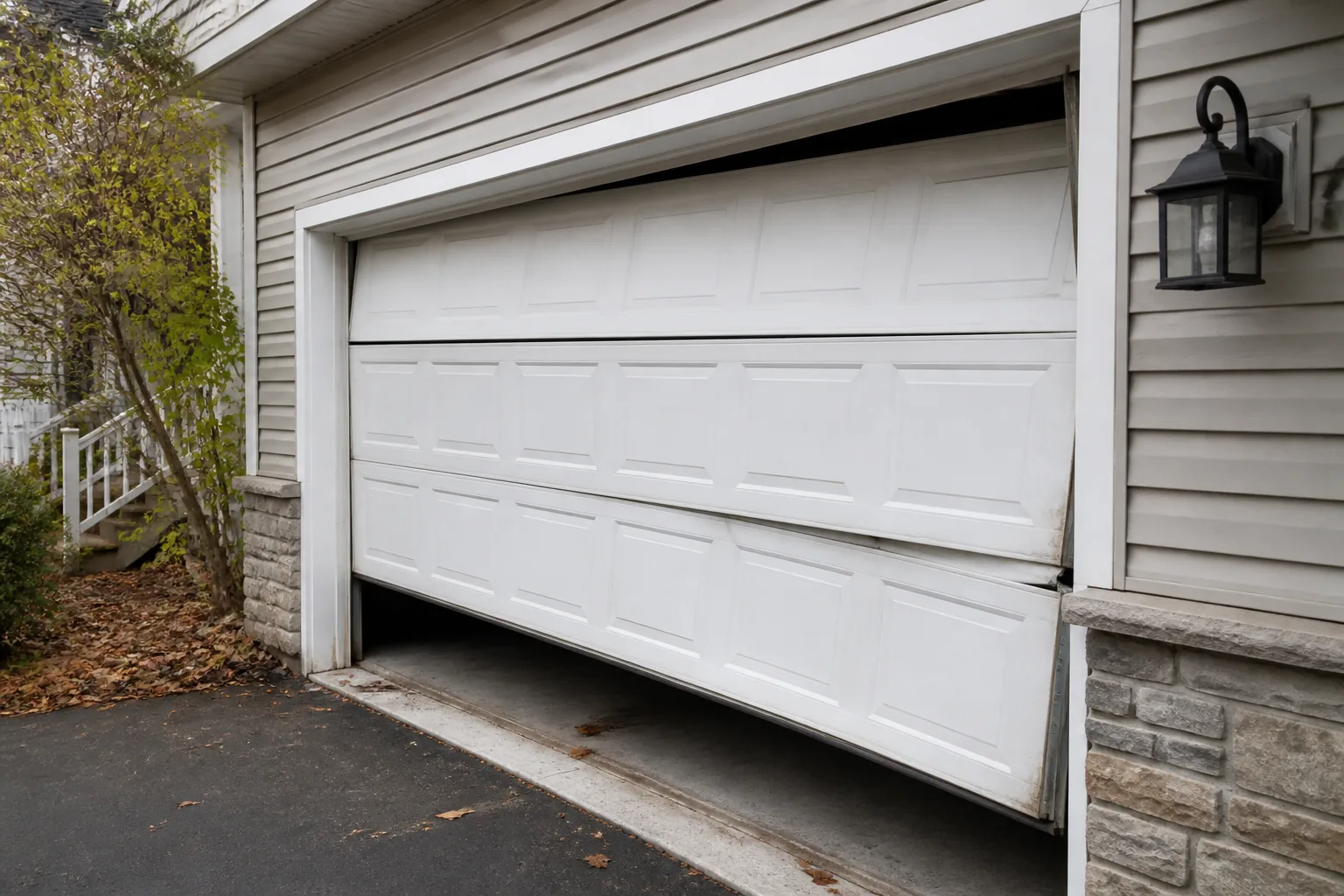
- Sagging panels. Step back and look at the door straight on. A panel that dips or a door that’s no longer square to the opening points to a balance or track problem.
One small comfort: hail isn’t really a concern in this part of Massachusetts, so most impact damage we see comes from a bumped track or a backed-into door rather than weather. Norwood’s winters are the bigger factor. Road grit finds its way into tracks and hinges, and the freeze-thaw cycle loosens brackets over time.
When can I wait, and when should I stop using the door?
Not every warning sign is an emergency, and we’d rather tell you which is which than sell you a repair you don’t need yet. Here’s the honest split:
Safe to schedule within the week
- Squealing or light grinding that’s new but steady
- A door that’s slow but still opens and closes evenly
- Uneven rust on rollers or hinges
- An opener remote or wall button that’s gotten finicky
- Occasional reversing that clears up once the sensors are cleaned
Stop using the door until it’s repaired
- Any frayed, slack, or snapped cable
- A door that’s visibly crooked, sagging on one side, or off its track
- A loud pop followed by the door not lifting at all (a broken spring)
- Any spring you can see has broken or come apart
- A door that reverses every time it closes, even with clear sensors
- Any door that’s been left hanging open because it won’t come down
A door stuck open isn’t only inconvenient. It leaves the whole house exposed, which is why the stop-using-it list matters. Our team handles garage door repair for exactly these situations, and because we service both the door and the opener, you’re not stuck coordinating two different contractors to get one problem solved.
Key Takeaways
- Sound, speed, and balance changes are early warnings, not quirks to live with.
- Grinding points to rollers or the torsion shaft, popping to springs or drums, squealing to dry hinges and rollers.
- A door that reverses on its own is usually a sensor issue, not a failing opener. Clean and align the sensors first.
- The 30-second balance test reveals spring trouble before a spring fully fails. Don’t touch the springs themselves.
- Frayed cables, a crooked door, or a snapped spring mean stop using the door until it’s fixed.
The Bottom Line
A garage door rarely fails without warning. It gets louder, slower, or out of balance first, and those are the moments when a repair is simplest. Catching the noise or the sag early means a smaller fix instead of a bigger one, and it means your opener isn’t quietly burning itself out lifting a door it was never built to carry. Whether your door is a Clopay, a Genie-equipped lift, or something else entirely, we work on the brand you already have. If you’re in Norwood and need help, Norwood Garage Door Repair offers free estimates. Call (866) 783-4096. We answer 24/7, with fast dispatch from 7am to 7pm, Sunday through Friday.
Frequently Asked Questions
Maintenance covers lubrication, tightening hardware, and adjusting sensors. Repair is needed when something is grinding, popping, out of balance, or visibly damaged. If the door passes the balance test and only squeaks, it likely needs lubrication. If it sags, reverses on its own, or makes grinding or popping sounds, that’s a repair. Call (866) 783-4096 and we’ll tell you which it sounds like before anyone comes out.
A single loud pop can be a spring under changing tension, and that’s worth treating with caution. Springs are the most dangerous component of a garage door system, and a broken one can cause serious injury. If you hear a pop and the door stops lifting, stop using it and call us. Don’t try to lift or adjust the door yourself. Call (866) 783-4096 so we can take a look.
That’s the safety sensor working, not the opener failing. Something is blocking the photo-eye beam, the sensors are misaligned, or the lenses are dirty. Clear the path, wipe the lenses, and check that both sensors point at each other. If it still reverses after that, the opener or its wiring needs a check. Call (866) 783-4096 and we’ll sort out which it is.
Light squealing can usually wait a week or two, but grinding or popping shouldn’t. Noise usually means a specific part is wearing, and the longer it runs, the more strain it puts on the opener and the rest of the system. A quick look now is cheaper than a replacement later. Call (866) 783-4096 for a free estimate and we’ll tell you what the sound is pointing to.
Call (866) 783-4096. We answer 24/7. Fast dispatch from 7am to 7pm, Sunday through Friday.
Written by the team at Norwood Garage Door Repair.
Need Garage Door Help?
Call Norwood Garage Door Repair - the local pro we connect you with is licensed and insured, here with fast help in Norwood.
(866) 783-4096